Connecting Design with Leadership
Jun 23, 2026
Part of the Design Strategy series, brought to you by The Designer MBA for Teams
In any organization with a great culture, leadership consistently encourages and invests in its growth. While culture does not always have to originate from leadership, its success hinges on leaders fully embracing it and creating the conditions for it to flourish.
This is equally true of design culture. Building a design-led organization requires more than empowering designers to do better work. It requires leaders at every level to understand what design is, champion its potential, and integrate it into the strategic fabric of the organization.
The Design-Curious Leader
One of the most common misconceptions about design leadership is that it must come from designers. It doesn't. What it requires is something more accessible and, ultimately, more powerful: curiosity.
The most effective design champions I've encountered across organizations share a set of traits that have nothing to do with design training. They are design-curious — eager to learn, understand, and explore what design can do for the business. That curiosity drives them to ask the right questions, invest in the right people, and position design as a strategic priority rather than a finishing touch.
In practice, this looks like a few specific behaviors. Design-curious leaders involve themselves in design discussions early, not to make design decisions, but to understand the reasoning behind them. They consult designers before committing to product direction, not after. They support initiatives that don't yet have proven ROI because they understand that design's value compounds over time. And they go beyond surface-level appreciation to grasp the underlying principles, building knowledge through direct engagement with strategies and outcomes, and learning as much from failures as from wins.
The examples of this in practice are plentiful, and they come from non-designers more often than not. Reed Hastings at Netflix invested heavily in UX research and embedded design thinking into product development despite no formal design background. Thomas Watson Jr. at IBM made "Good design is good business" a company-wide principle decades before design had the business credibility it holds today. Neither of them designed anything. What they shared was a willingness to understand design deeply enough to champion it at the strategic level and to create the organizational conditions for it to matter.
That is the posture. The specific industry, background, or title is secondary.
The Challenges Leaders Face
Leadership support for design is not without friction. With any significant cultural initiative, leaders will encounter resistance to change: skepticism about the value of design, anxiety from ambiguous goals, difficulty in quantifying results, and tension between siloed departments and the longer-term nature of design transformation. As a leader, the role is to help define that ambiguity and steer with strategic and cultural influence.
Three areas, in particular, determine how effectively leaders can overcome these challenges: investment, metrics, and strategic integration.
Investment
Before leaders can invest in design effectively, they need a model for what they are actually investing in.
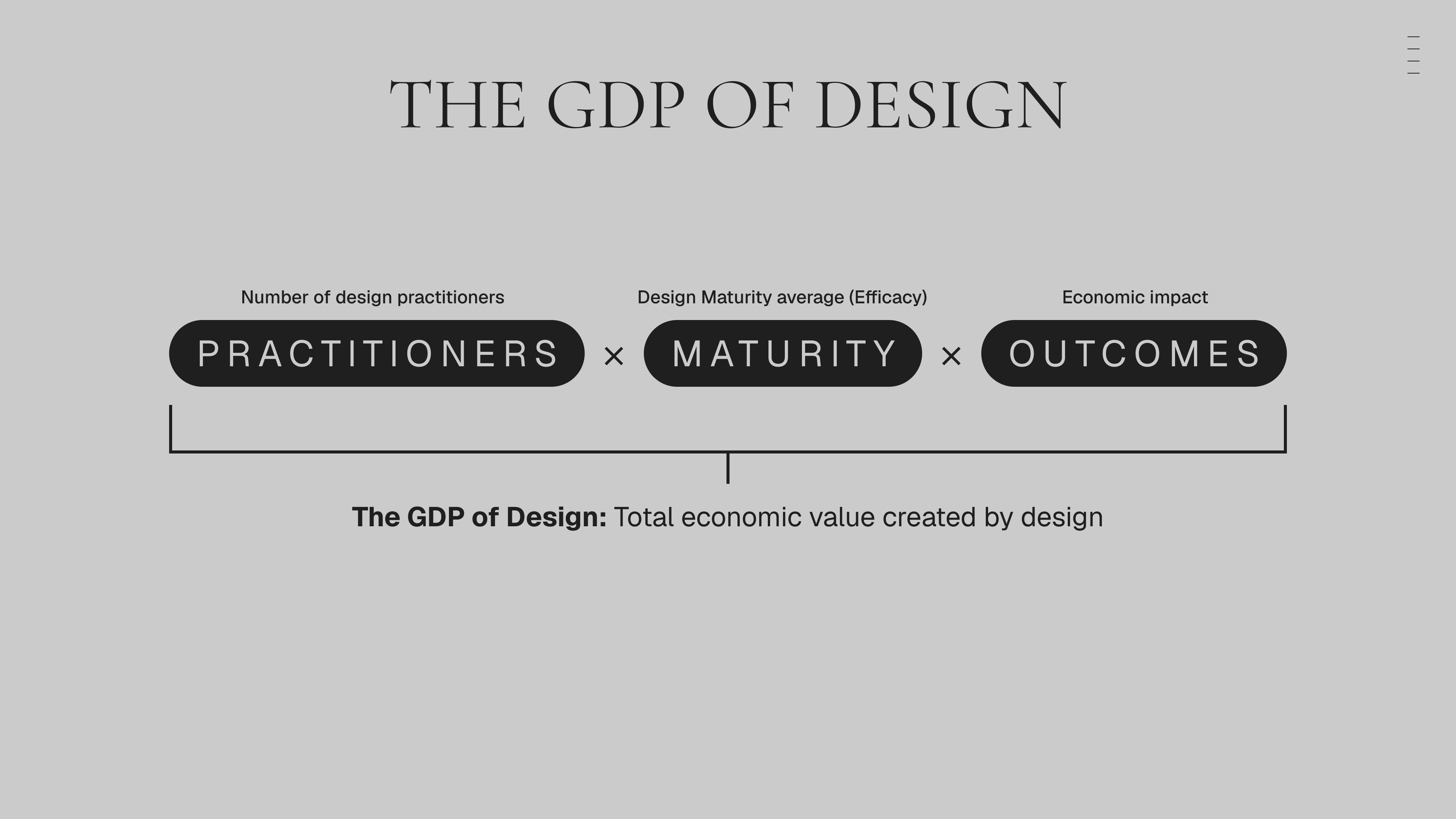
I think of this as the GDP of Design — the total economic value that design creates within an organization, expressed as a function of three interdependent factors: the number of design practitioners actively applying design, the maturity of how design is practiced, and the quality of the outcomes that design produces. Multiplied together, these three levers determine how much value design generates. Improve any one of them and output rises. Let any one of them stagnate and the others are constrained.
This framing matters for leaders because it clarifies where investment actually moves the needle. Hiring more designers only compounds if the conditions for effective practice exist. Raising maturity through systems, education, and process creates the platform that makes each practitioner more effective. And connecting design directly to business outcomes ensures that gains in practice translate into gains the organization can measure. Leaders who invest in all three simultaneously are the ones who see design compound over time rather than deliver in isolated bursts.
Creating a lasting culture of design adoption requires proactively fostering the right conditions across all three levers. This means people: supporting design talent acquisition, skill development programs, and the cultivation of design leadership that can bridge the gap between design and business. It means tooling and literacy: allocating budget and resources for design tools and training so that non-designers can participate meaningfully in the process. And it means strategy and vision: allocating dedicated resources for design initiatives and providing design teams with the autonomy to explore innovative solutions.
Leaders may face real obstacles here: budget constraints, resistance from other departments, or difficulty demonstrating ROI in the short term. A practical response is to begin with a phased approach, starting with small, high-impact projects that demonstrate value before pursuing larger initiatives. Collaborating with finance teams to develop metrics that align design outcomes with business goals helps build a shared language around design's contribution. Cross-functional partnerships that show how design investment benefits multiple areas of the organization can further strengthen the case.
Metrics
Investment without accountability is aspiration without direction. When measuring the success of design culture, metrics typically fall into two categories: design adoption metrics and result metrics.
Design adoption metrics capture how broadly and actively the organization is engaging with design. These include engagement with design tools and resources, participation and completion rates in training programs, the volume of cross-functional projects involving design, and the frequency with which design system components are used and contributed to by non-designers.
Result metrics capture the business impact of that engagement. Customer and user feedback on design quality, improvements in sales and conversion rates attributable to design changes, and retention metrics are all relevant here. Culture impact metrics, such as employee satisfaction surveys focused on design culture and processes, round out the picture.
The difficulty is that defining the right metrics requires an honest reckoning with context. What an organization values depends on its culture, business phase, industry, and strategic goals. The metrics above are illustrative, not universal. The measurement process itself should be iterative, evolving to reflect changing priorities.
For outcomes that resist quantification, a balanced scorecard approach combining quantitative metrics with qualitative assessments provides a more complete view of design's impact on both business performance and organizational culture.
Strategic Integration
Beyond investment and measurement, leadership must actively integrate design into strategic planning and decision-making. This means connecting design adoption to organization-wide goals and vision, incorporating design thinking into how challenges are framed, and including design leaders in high-level strategic discussions so their expertise shapes the company's direction.
The single biggest predictor of design maturity I've observed isn't the quality of the designers. It's the posture of leadership. During my time as Design Advocate at Figma across APAC, I worked with hundreds of organizations, from enterprise teams at DBS Bank, Singapore Airlines, and Recruit in Japan, to growth-stage companies across Southeast Asia. The organizations making real progress shared a common trait: leaders who were in the room asking design questions, not just approving design outputs. They had connected design to the outcomes they personally cared about: faster product cycles, stronger customer retention, differentiation in increasingly commoditized markets. Design had become part of how they thought about competitive strategy. Not a separate function that reported up to them.
The resistance that often follows integration efforts is predictable. In organizations with traditionally siloed teams, the question "Why do I need design? I'm not a designer" will surface. The answer is not to sell design as a discipline but to frame it as a means to a goal the entire team already cares about. Setting a vision, whether building a best-in-class product, disrupting a category, or redefining the customer experience, and then positioning design as the tool that helps the team reach that destination is more durable than any argument for design on its own terms.
It is also necessary to approach integration with realistic expectations. While design is a powerful tool with significant potential, its successful integration requires patience and a measured rollout. Avoid overselling design or setting unrealistic expectations before results have been demonstrated. Start with small-scale initiatives that build trust, use those early wins to create momentum, and then pursue more ambitious design initiatives from a position of organizational confidence.
Committing to Long-Term Outcomes
Design thrives on a holistic approach, where the combined effect of many interconnected decisions exceeds the sum of their individual parts. A single design initiative, viewed in isolation, may appear to deliver modest value. Viewed as part of a coherent, cumulative strategy, the same initiative contributes to something much more significant. Creating a culture of design within an organization is no different.
This is why the most effective approach to design adoption is outcome-driven rather than results-driven. Results-driven strategy optimizes for extracting value from what exists today: measurable outputs, quarterly KPIs, incremental gains. Outcome-driven strategy is about creating a demonstrable change in the way people think and behave to bring about a desired future state. The two approaches are complementary, not competing. But leaders who only manage to results will consistently underinvest in design, because design's most significant impacts are often the slowest to emerge.
I've written about outcome-driven strategy in depth here. The short version as it applies to design: define the organizational state you're trying to create, then work backwards into the initiatives that move you toward it. Stripe's mission to "increase the GDP of the internet" is the cleanest example — an outcome so clearly defined that it generated an entirely new product category in Atlas, reducing barriers for online businesses to incorporate and collectively enabling more than twenty thousand companies to generate over three billion dollars in revenue within five years. Not a results target. An outcome they designed toward.
For leaders building design culture, the equivalent question is: what does this organization look like when design is working? Not what metrics improve — what changes about how people think, decide, and build? Answer that, and you have the north star that makes every investment decision easier to evaluate.
Design Is a Strategic Investment
Ultimately, design is not a function to be managed. It is a strategic investment to be cultivated. Reaping its full benefits requires patience, focus, and sustained commitment over time, where results are often tracked over years rather than months or quarters.
The leaders who have most successfully integrated design into their organizations share a common posture. They remained curious rather than prescriptive. They invested continuously rather than episodically. They framed design not as an end in itself but as a means to outcomes the entire organization cared about. And they committed to the long-term work of culture change, understanding that the most significant impacts of design are often the slowest to emerge.
If you're a leader who's been on the fence about design, unconvinced by the pitch, uncertain about the ROI, or skeptical that it applies to your industry, the question worth sitting with is not whether design has business value. Decades of data have settled that. The question is whether your organization is capturing it. And the answer to that question depends almost entirely on you.
This article is part of the Design Strategy series, brought to you by The Designer MBA for Teams — a training program for product teams looking to connect design with strategic business outcomes.
Continue Reading
All articles →