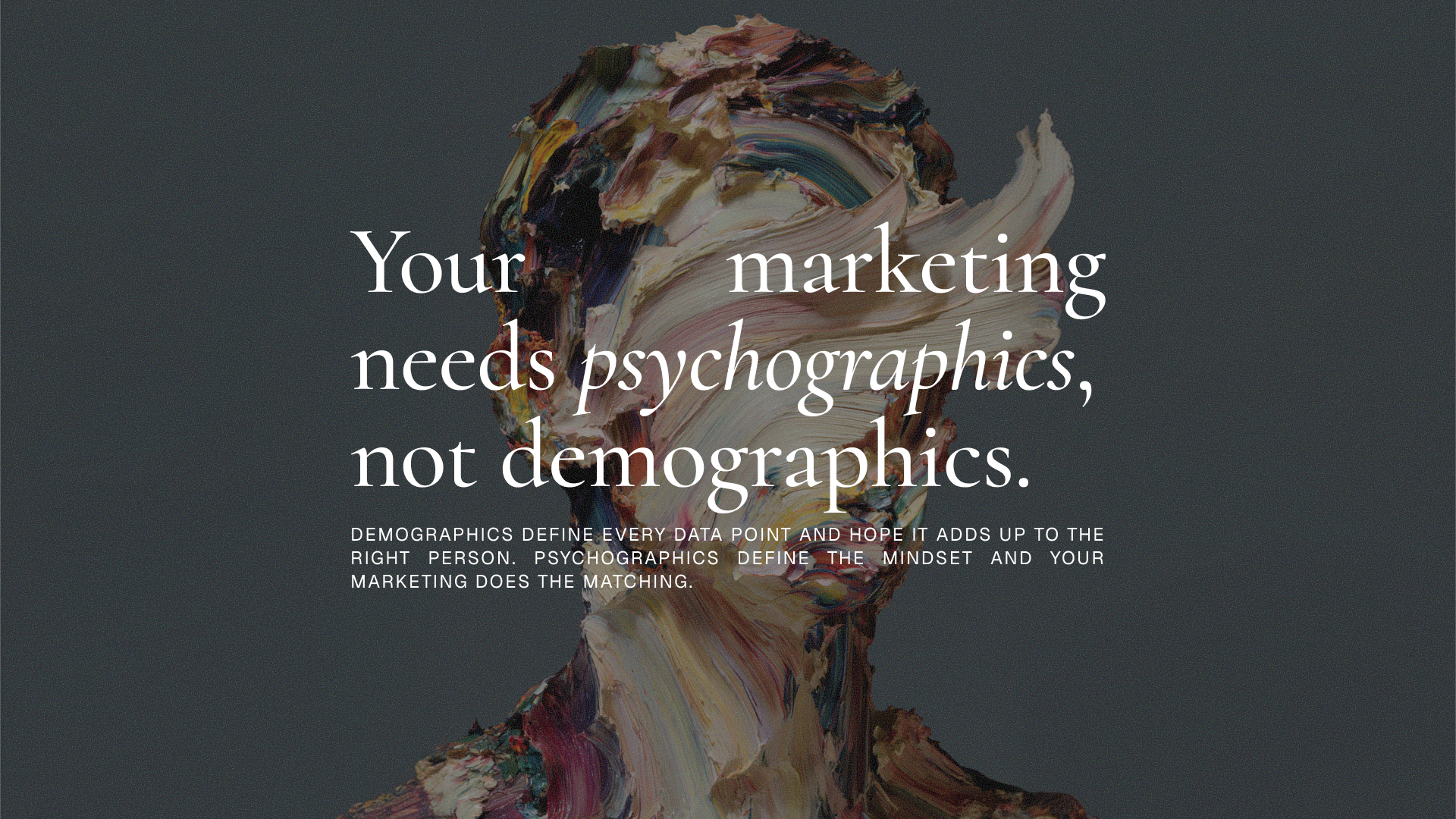
You need psychographics, not demographics.
Apr 08, 2026
6 months ago I started an experiment. I built a content marketing engine entirely based on attracting my target audience with a psychographic profile.
No demographic targeting. No job titles, age ranges, or location filters. Just messaging built around a specific state of mind.
I wanted to know if understanding why people buy was more powerful than knowing who they are.
The results were hard to argue with. My organic content started attracting the right people without me having to define who they were. My ads generated between 10x and 20x ROAS with zero demographic targeting.
But the bigger realization was that most people are building their ideal client profile the wrong way.
Why demographics don't work
Demographics are an imperative approach. That means you have to manually define every possible data point that describes your ideal client, then hope you got it right. Too broad and you attract the wrong people. Too narrow and you filter out a huge chunk of your actual market. And if your ideal clients have conflicting data points across different segments, a demographics approach simply can't reconcile that.
The deeper problem is this: no matter how many data points you stack up, it will always be a rudimentary way of understanding a person. Could you use demographics alone to understand someone's motivations, struggles, and desires? Probably not. And that's exactly what effective marketing requires. Demographics don't tell you what people believe in, what they care about, or what drives their decisions.
Why psychographics work
Unlike demographics, psychographics are declarative. Instead of trying to define every possible characteristic of your ideal client, you just need to understand their psychological state. What do they value? What keeps them up at night? What do they dream about? That psychological profile is what actually leads someone to a purchase decision.
And because you're designing your marketing around a state of mind rather than a checklist of traits, you stop accidentally filtering out client segments you never thought to define. The right people find you because of how your message makes them feel, not because you happened to describe their job title correctly.
When your messaging is built on psychographics, people feel like you're speaking directly to them. Like you already know them before you've even met.
Here's the simplest way to think about it. Demographics are imperative. You define every data point and hope it adds up to the right person. Psychographics are declarative. You define the mindset and your marketing does the matching.
In practice
The most effective way to integrate psychographics into your business is through content.
My content doesn't target people by job title, years of experience, or follower count. It speaks to a specific state of mind. People who are stuck in survival mode. People with bigger ambitions but no clear path to get there. People who know their skills aren't the problem.
That's a psychographic profile. And it works across every channel.
I apply the same logic to my ads. Zero demographic targeting. No age ranges, no job titles, no location filters. Just messaging built around a psychological state. That approach generates between 10x and 20x ROAS.
If you've read this far, you probably match that profile. Which means you already know this works. You just experienced it. The question is whether your content is doing the same thing for your business.
If you want to understand how to apply this to your business, feel free to send me a message.